


Comfortable in the Contradictions, Dino Fetscher in Conversation
- Vingt Sept

- Jan 29
- 5 min read
Updated: Feb 2


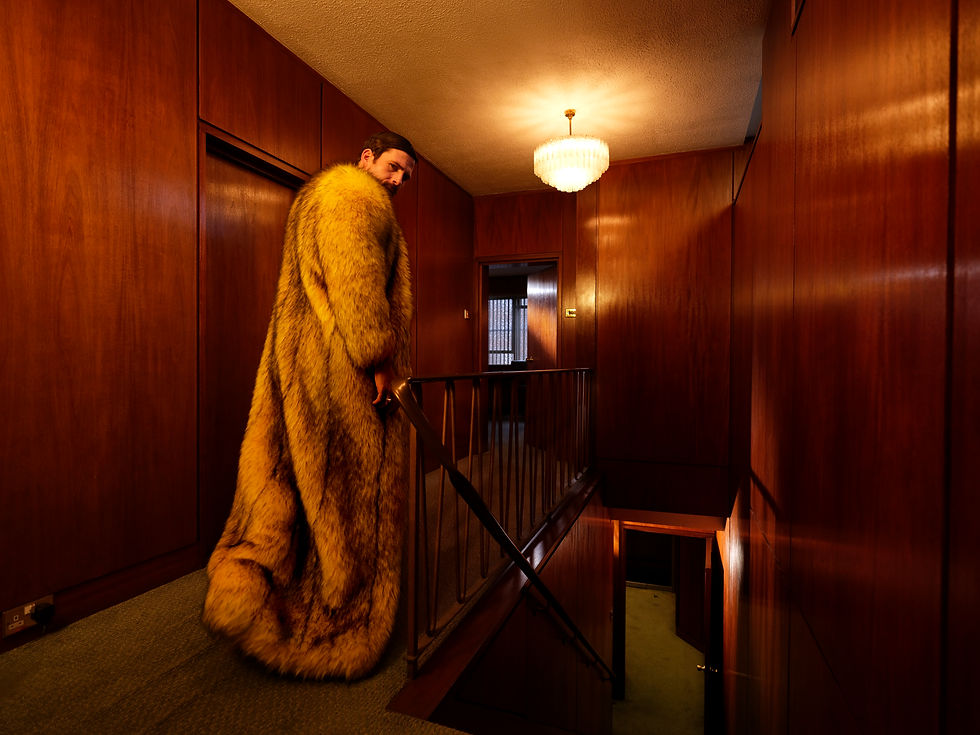
I arrived on set a little later than everyone else. Dino Fetscher was already there, standing centre frame in a bright yellow fur coat. It was flamboyant, theatrical, and entirely at ease. He wore it with the kind of confidence that does not ask to be understood.
There was something immediately striking about the contrast. A traditionally masculine presence paired with something deliberately playful. Not a statement, not a performance. Just comfort. It felt like a quiet introduction to the way Fetscher moves through the world, and through his work.

Fresh from a playful, character-driven shoot, Fetscher sits down to talk about momentum, theatre as ritual, comedy as resistance, and the kind of work that stays with people long after it ends.
Despite the growing visibility of his career across stage and screen, he does not experience it as forward motion.
“I’d probably say it only makes sense when I look back,” he says. “I think I can be quite unpresent and chaotic in lots of areas of my life, but with my work, I am all in. I am very focused and very much in that world. It blocks out a lot of other stuff.”

It is only later, often through other people, that the scale of it becomes clear. Someone mentions a play they saw. A series that stayed with them. Only then does the accumulation reveal itself.
Finding the Work
That instinctive relationship to projects comes up again when we talk about Oh, Mary!
“It was really weird. Almost spooky,” he says. A former collaborator from The Normal Heart texted him asking if he had heard of the play. He had not. “He just said, there is a part you would be great for.”

The script was not available in the UK, so Fetscher ordered it from New York. “As soon as I was a few pages in, I thought, this is something really special,” he says. “It is very different from other work I have done, but also a flex that feels very me.”
His response was immediate. “I laughed out loud. Proper cackling. Joy,” he says. “It was very effusive. Like okay - how do I do this? How do I get in?”

What struck him was not just the humour, but the intelligence of it. “It feels like a love letter to theatre,” he says. “There is Chekhov, Old Hollywood, Fassbinder, all filtered through Cole Escola’s mind.”
The Power of Comedy
Though Oh, Mary! is playful and absurd, it is deeply interested in repression and emotional constraint. For Fetscher, comedy is not a softening of truth but a direct route to it.
It is also, quite simply, extremely funny. When I saw the play, the room was in constant laughter, the kind that builds and spills over, driven by precision, physicality, and a total commitment to the ridiculous.

“Comedy and humour are really vital tools,” he says. “You crack people, you make them laugh, you make them love you, and you draw them in. And once they are in, you can really undercut that.”
Fetscher goes on to explain how comedy ‘lowers defences.’ It allows difficult ideas to land without resistance. “It lets you hit people right in the heart,” he says. “Almost like a sucker punch.”
In a moment where the world feels relentlessly heavy, Oh, Mary! offers something deceptively radical.

“For eighty minutes, people get to step into this ridiculous, very silly, but incredibly clever world and just be transported,” he says. “Holding onto joy and absurdity feels like a form of protest. It keeps us strong and able to keep going.”
Theatre as Ritual
When Fetscher talks about theatre, he speaks about it less as a job and more as a practice. There is something almost ritualistic in the way he describes being on stage, live with an audience, night after night.
“It is almost shamanic,” he says. “Being live with an audience is something humans have done since the dawn of time.”
What matters to him is the exchange. The fact that no two performances are ever the same. The audience shifts. The energy shifts. The night belongs to a single moment in time. Once it passes, it cannot be revisited. That impermanence, he says, is what gives it weight.

He speaks fondly of rehearsal rooms, of time spent building something collectively before it ever reaches an audience. It is one of the few things he misses when working on screen, where preparation time is often minimal and momentum is expected immediately.
Theatre demands endurance, presence, and trust. It is physical. It is technical. It asks for full commitment. When he has not done a play in a while, he feels it. “I really crave it,” he admits.
Between Stage and Screen
Fetscher moves fluidly between theatre and screen, something he attributes to temperament rather than strategy.

“I have always wanted my career to be eclectic,” he says. “I love variety. I have quite a short attention span, and if I do one thing for too long, I get bored.”
Where theatre demands stamina and presence, screen work asks for restraint. Acting for camera requires precision and specificity - small adjustments that carry enormous weight. He enjoys the collaboration of it, the scale, and the way so many moving parts come together over time.

Rather than competing, the two mediums exist in conversation. Each offers something essential. Each keeps him creatively alert.
Audience and Impact
When the conversation turns to audience, Fetscher becomes more reflective. Across his body of work, meaning has become a clear throughline.
“Humans was about immigration and what it means to be human through a sci-fi lens,” he says. “The Normal Heart connected generations. People who lived through the AIDS crisis and young queer audiences who never learned about it.”

He speaks about art as something that reaches people before it explains itself. Less about persuasion or instruction, more about creating space for feeling. For him, emotion comes first. Meaning follows.
“That is what art can do,” he says. “It reaches people in a way lectures cannot.”
Work That Remains
Balancing Oh, Mary! alongside the darker world of Under Salt Marsh, Fetscher does not feel more at home in one tone than another.

“Honestly, both,” he says. “Drama lets you get under the skin of a character, build backstory, understand why a moment matters. But Oh, Mary! asks something completely different. It is ridiculous, huge, very physical, and very technical. They feed me differently.”
What ultimately draws him to a role is challenge paired with meaning. Stories that push him. Stories that reach people’s hearts and minds.
When asked what kind of work he hopes to be remembered for, his answer is simple.
“Work that sticks.”
It is a quiet philosophy, delivered without spectacle.
Much like the man in the yellow fur coat.
Photography and Creative Direction Arabella Itani
DOP and Editor Joseph Lewiston
Movement Direction Lee Jay Hoy
Styling Becca Ahern
Styling Assistant 1 Jaden Salman
Styling Assistant 2 Charlotte Kelsey
Grooming Jon Chapman
Makeup Sogol
Set Design Abi Hanah
Interview Caiya Griffith
Editorial Director Philipp Raheem
Location A beautiful Place to Get Lost Agency


Comments