


Humble Grape Canary Wharf: Where Wine Becomes a Conversation


Wine has a way of making people feel as though there is a right answer. The right grape, the right region, the right words to describe what is in the glass. At Humble Grape Canary Wharf, the experience feels much less like a test and much more like an invitation to be curious. A wine tasting here isn't about proving how much you know, but discovering why a particular bottle has made its way onto the table.
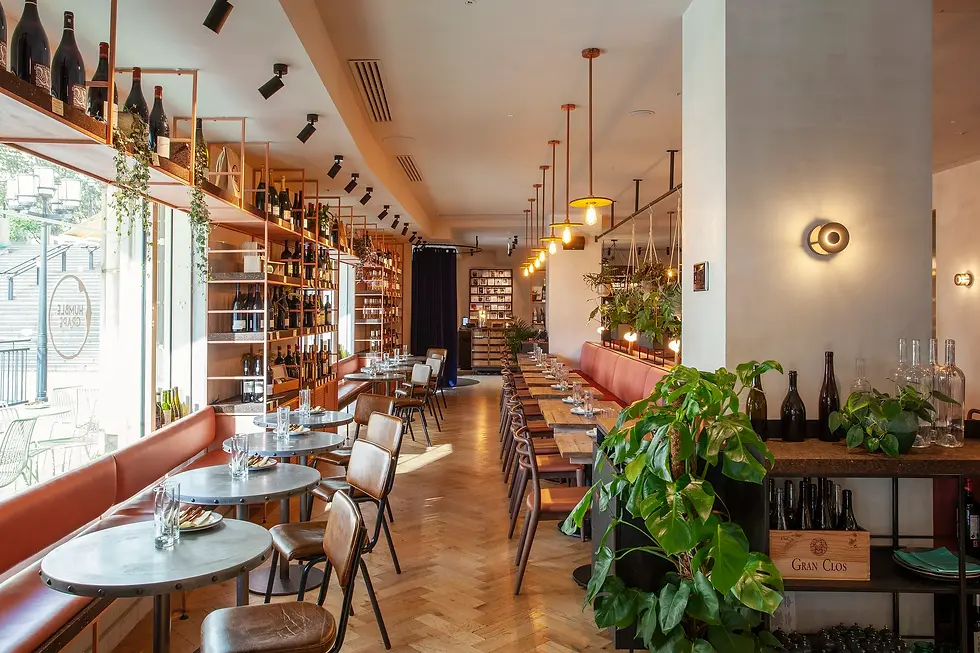
That philosophy is reflected in the space itself. There's nothing overly formal or intimidating about it. Brass Edison lights hang above shelves stacked with bottles, plants soften the industrial metal tables and parquet flooring, while short leather booths create an intimacy that makes the room feel more like a neighbourhood wine bar than somewhere designed to impress with its credentials.

The bottles are everywhere, but they never feel like a warning to know your Bordeaux from your Burgundy. If you are seeking to see the views of London's busiest financial district over the water, a seat outdoors is also a perfect choice.
Our tasting, hosted by Maxwell, began with food and Champagne before moving through four very different reds. There was lamb carpaccio with pickled cherries, chicken with grape, charcuterie and bresaola, sourdough and, naturally, plenty of wine to keep the conversation moving.
The Cuvée Prestige Champagne, at £119 a bottle or available by the glass, was a particularly interesting introduction. A blend of 60 per cent Chardonnay and 40 per cent Pinot, it comes from a small family-and-land supplier connected to producers who have supplied houses including Dom Pérignon and Bernard Lonclas. The estate is run by an owner in his seventies and his daughters, bringing together decades of experience with a younger generation now helping to shape what comes next.

Our bottle had been disgorged in 2024, with an ageing potential of around ten years. Paired with charcuterie and bresaola, it was a reminder that Champagne can be about much more than celebration. There is the land, the family, the patience and the decision-making that goes into every bottle long before it reaches the glass.
The first red took us somewhere completely different. The Würzberg Pinot Noir 2022 from Germany came from a cooler climate and was light, earthy and refreshing, with none of the heaviness that can sometimes dominate a red-wine tasting. The vineyard is women-owned, part of what the producers refer to as 'Women in Wine', adding another story to a bottle that already demonstrated how much regional conditions can influence what ends up in your glass.
Then came Bordeaux, and with it a lesson in geography. The wine came from the Right Bank, where Merlot dominates, rather than the Cabernet Sauvignon-led Left Bank. With 95 per cent Merlot, it offered an opportunity to understand the distinction through tasting rather than a textbook. The producers also work with young, up-and-coming winemakers, using old French oak while involving the younger generation throughout the winemaking process.

It was this element that particularly appealed to Maxwell. His choice was not based purely on what the wine tasted like, but on the emotion behind bringing different generations of winemakers together. Even the bottle rewarded attention, with its lot number sitting below the year.
The third wine, from Ocults Argentina Vineyard, shifted the mood again. This was concentrated and fruit-forward, coming from a young vineyard and using gas to crush the grapes. There was even a small visual detail to discover, with a Golden Flower or bee emblem appearing on the stem of the bottle. It was another reminder that wine tasting becomes far more interesting when you start paying attention to the details beyond the liquid itself.
The final wine took us to Priorat and considerably further back in time. Finca El Puig comes from vines more than 100 years old, labelled as nineteenth-century vines, and is produced in a difficult agricultural region around 40 miles outside Barcelona. The wine had been decanted before we tasted it, giving it time to open up, and its story was as much about the terrain as the age of the vines. Even the back of the bottle carries a description that encourages you to pause and read rather than immediately reaching for the next glass.
Perhaps that's what makes Humble Grape interesting. It takes something that can easily become overly serious and puts the people back into it. A family estate, women running a vineyard, young winemakers learning from tradition, a difficult landscape, a particular method of crushing grapes. Suddenly wine is no longer just about whether you can identify a tasting note. It's about the people who made it and the decisions that brought it to your table.
There are plenty of ways to explore that philosophy without committing to a full tasting evening. Saturdays pair Burger + Bordeaux for £20, while Mondays offer all wines, including Champagne, at retail price. The monthly wine flight is perhaps the easiest introduction, with four different wines for £18, each month focusing on a particular region or grape variety.
For anyone who has ever stood in front of a wall of wine and felt they should know what they were looking for, Humble Grape offers a rather welcome alternative. You don't need to know everything before you arrive. You just need to be interested enough to ask what is in the glass.
Humble Grape Canary Wharf
Address: 18-20 Mackenzie Walk, Canary Wharf Estate, London E14 4PH
For more information, visit HERE
Photography courtesy of Humble Grape
Words by Jheanelle Feanny


Comments