


LOEWE SS27: JACK MCCOLLOUGH & LAZARO HERNANDEZ REDEFINE EVERYDAY DRESSING


For Spring/Summer 2027, Jack McCollough and Lazaro Hernandez explored the meeting point between American pragmatism and Spanish heritage, presenting a collection that brought an unexpected sense of ease to LOEWE's experimental design language.
There's an interesting dialogue unfolding at LOEWE under Jack McCollough and Lazaro Hernandez. The American design duo, whose appointment marked a new chapter for the Spanish luxury house, have begun establishing a visual identity that draws upon their own experiences while remaining connected to the craftsmanship and cultural heritage that have long defined the maison.
For Spring/Summer 2027, presented in Paris on 2 October, the designers turned their attention towards the relationship between clothing and everyday life. The collection explored how familiar wardrobe pieces could be transformed through subtle adjustments to construction, unexpected fabric choices and a more instinctive approach to dressing.

It was a meeting of two seemingly contrasting worlds. The relaxed practicality of coastal New England informed the collection's foundations, while the theatricality of Spanish Baroque design and the warmth of Andalusia introduced a more expressive dimension.
Rather than treating these influences as competing aesthetics, McCollough and Hernandez brought them together through a wardrobe that balanced utility with an appreciation for the unexpected.
Colour provided one of the collection's most immediate points of interest. Modernist colour blocking introduced a graphic quality, with contrasting shades bringing definition to silhouettes that might otherwise have appeared relatively understated. Against these sharper combinations, the influence of Spanish decorative traditions introduced a sense of drama, although the overall approach remained remarkably controlled.

The designers' interest in familiar clothing archetypes became apparent through the reinterpretation of everyday garments. Polo shirts were cut backwards across the body, creating the impression of having been removed and hastily pulled on again. It was a deceptively simple adjustment, but one that altered the relationship between the garment and the wearer, introducing a sense of spontaneity to an otherwise conventional piece.
Elsewhere, the familiar shape of a basketball jersey provided the foundation for a chiffon slip dress finished with delicate beaded fringe. The contrast was particularly effective, transforming the language of sportswear into something considerably more fluid and decorative without losing the recognisable proportions of its original inspiration.
Outerwear received a similarly unconventional treatment. Anoraks, traditionally associated with practical protection against the elements, were reimagined in silk, their lightweight construction encouraging a more intimate relationship with the body. Worn directly against bare skin, the garments challenged expectations surrounding both fabric and function.

Trench coats and lightweight knitwear introduced further experimentation through collars fashioned from sunglass resin. The material provided an unexpected structural element, contrasting with the softness of the surrounding fabrics while reinforcing LOEWE's longstanding interest in material innovation.
Accessories continued the conversation between familiarity and reinvention. Boat shoes, a staple of traditional American coastal dressing, were softened and finished with contrasting laces, bringing a subtle sense of playfulness to an otherwise practical design.
What made these transformations particularly interesting was their apparent simplicity. Rather than relying on elaborate construction to demonstrate technical ability, McCollough and Hernandez explored how small changes could alter the character of an established garment.
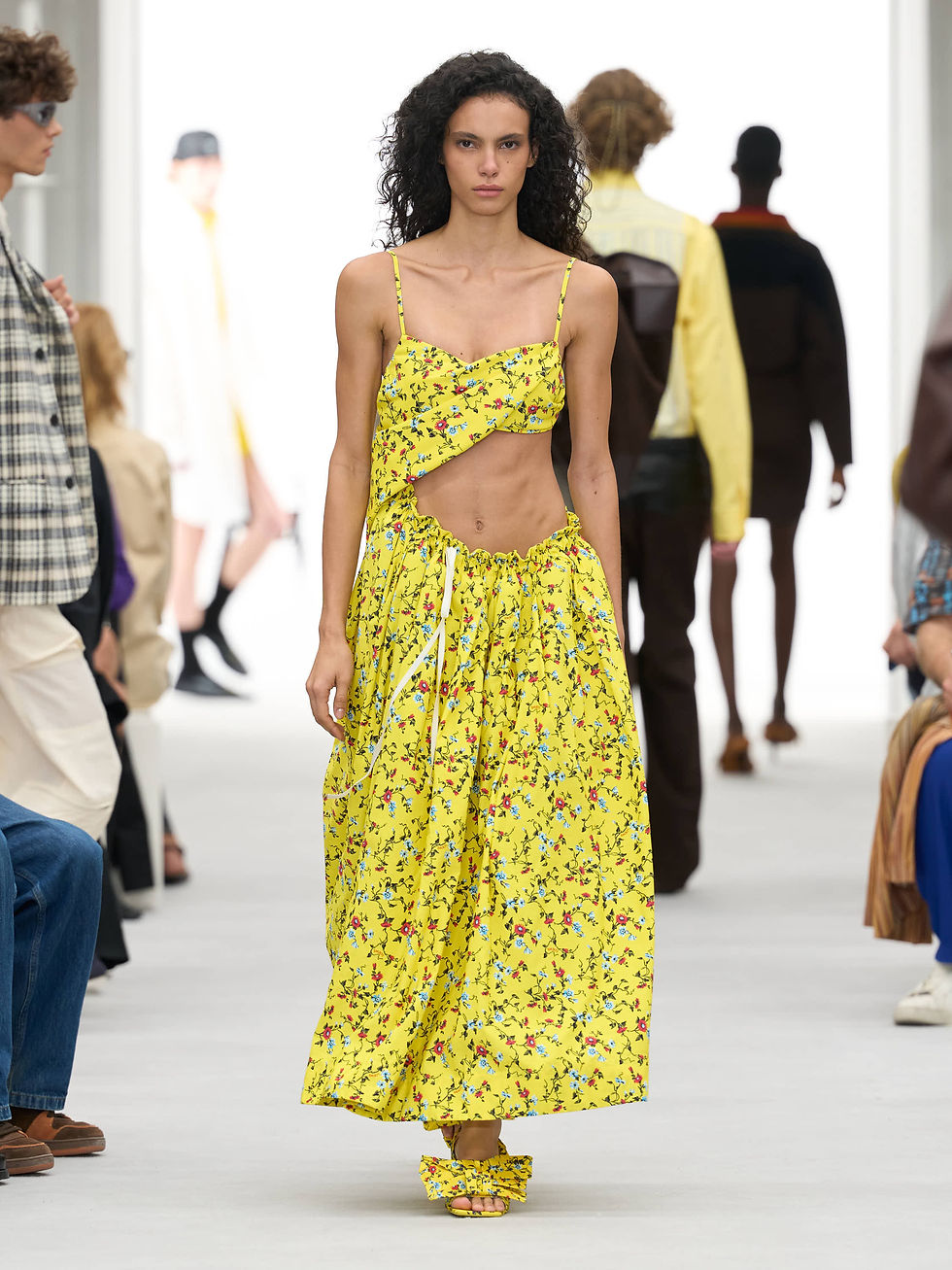
The collection also revealed an increasing interest in the physical experience of clothing. Fabric, proportion and movement were approached through the relationship between the garment and the body, with an emphasis on how pieces might feel rather than simply how they appeared.
It is a distinction that often becomes overlooked within luxury fashion, where the visual impact of a runway presentation can sometimes take precedence over the realities of wearing the clothes.
Here, the designers appeared interested in closing that distance. Their interpretation of luxury was not defined exclusively by craftsmanship or exclusivity, but also by the more personal qualities that allow a garment to become part of someone's everyday wardrobe.

The autobiographical references added another dimension. New England's influence was not simply an aesthetic choice, but a reflection of the designers' formative years and the women whose style shaped their understanding of clothing.
Against this, LOEWE's Spanish idenity provided a contrasting cultural perspective, introducing references to history, ritual and decorative expression.
The resulting collection avoided the temptation to resolve these differences into a single, easily identifiable aesthetic. Instead, it suggested that personal style is often shaped by contrasting experiences, places and memories.

For McCollough and Hernandez, this appears to be an important part of establishing their vision for LOEWE. The challenge is not simply to introduce a new design language, but to translate that language into clothing that feels relevant beyond the runway.
Spring/Summer 2027 offered an intriguing response. There was experimentation, certainly, but it was grounded in recognisable garments and familiar dressing habits. The more unusual details served to reconsider everyday clothing rather than distance it from the wearer.
For more information, visit HERE


Comments